September 29, 2026
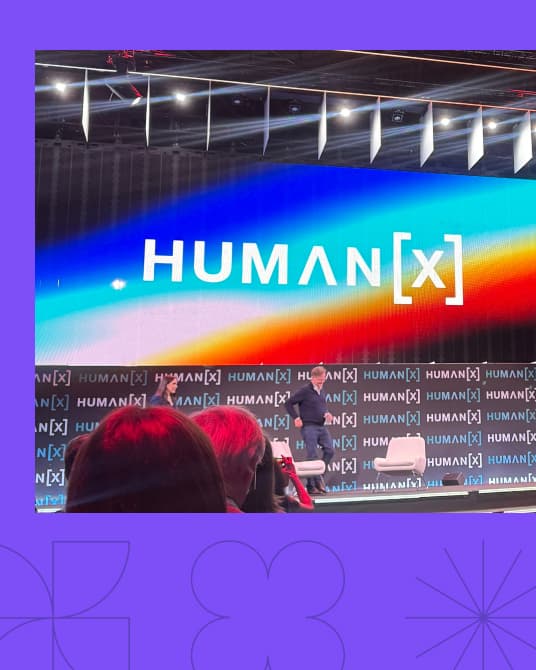
Human X landed in Amsterdam last week for its first European edition, bringing together two days of conversation about where AI is heading and what it takes to build with it. The most telling signal wasn't any single talk. It was the expo floor. The number of product providers now offering to support organisations on their AI journey has grown enormously, and fast. Agents, voice, orchestration, evaluation, governance: there is a tool for every layer. That's exciting, but it also makes cutting through the noise harder for the businesses trying to make sense of it all.
Across talks from Webflow, AWS, Booking.com, Diageo, Otter, PolyAI, Heathrow airport and IKEA, a few themes kept coming back: hyper-personalisation, websites moving from static pages to interactive experiences, reducing complexity rather than chasing efficiency, and asking what AI can actually contribute rather than what it can squeeze out. Below are three perspectives from the Tangent team who attended.
Richard Trigg, Chief Design Office
My takeaway from Swami Sivasubramanian's talk is that UX prototyping should compound, not create a trail of isolated demos. His framing of compounding momentum and infrastructure that compounds applies directly to design systems. Each prototype should reuse shared interaction patterns, governance and evaluation criteria, then feed its learnings back into the system.
The goal is not to prototype more AI features, but to prove a clear user and business outcome, expand trust gradually, and make every successful pattern easier to reuse in the next experience.
Nadine Clarke, Chief Strategy Officer
The thread I kept pulling on was trust. In the Booking.com and Diageo conversation, the view was that agents are still largely a toy for consumers. People are happy to explore with them, but most still won't let an agent book on their behalf. AI has made discovery easier, but it hasn't solved the bottom of the funnel. Users are asking two questions when they engaging with an agent: is it good enough to solve my problem, and do I trust it? And that judgement is made within the first two or three turns of a conversation. Much like in real life, you never get a second chance to make a first impression, and that also seems to apply to agents.
For me this reframes the conversation around "what can AI do" versus "what should we do". The ability to ship more features, faster, is not a strategy. The organisations that win will be the ones that stay anchored to the customer problem and earn trust early, rather than adding capability for its own sake.
James Scott-Flanagan, Head of Consultancy
The build vs buy debate is one of the oldest arguments in technology. AI has brought it back into focus, and made it harder to answer.
That's because AI now plays two roles. It's the tool: we can use it to build traditional software faster than ever. It's also the product: something we put directly into employee and customer experiences. So the question is no longer just whether to build or buy. It's what to build, what to buy, and what to wait for.
James Waters from Booking.com spoke about The True Cost of AI. He described how Booking.com put significant time and money into bespoke AI solutions, only for the frontier models to release the same capabilities soon after.
That raises a harder question. Should we default to buying, and let the frontier models catch up? Or is waiting the bigger risk? Getting to market first can still create real advantage and value, even if that capability is commoditised later.
I suspect the answer is less about build or buy, and more about knowing which bets are worth making. Maybe that's the true cost of AI. It isn't just tokens and licences. It's the cost of backing the wrong thing, at the wrong time.
What next
If there was one message running through the whole event, it's that the technology is no longer the hard part. Trust, focus and knowing where AI genuinely adds value are. HumanX returns to the US early next year, and it will be interesting to see how far the conversation has moved on by then!