July 6, 2026

Finding the right AI use case is the beginning. The harder part, for most organisations, is getting funding approved.
That means quantifying business value and building case to prove it, this is where many AI programmes quietly stall. Not because the idea is wrong, because the standard being applied has changed and most teams have not caught up with it yet.
Boards and finance teams that once approved technology spend on the strength of a compelling narrative are looking even more at impact on the top and bottom line. The share of companies abandoning AI initiatives before they reach production jumped to 42% in 2025, up from 17% the year before (S&P Global Market Intelligence). The era of AI investment on hype alone is coming to an end.
Who is typically charged with building out these business cases?
There are typically two groups who end up responsible for building the business case to justify AI investment.
The first are marketing and digital teams who for most of their careers haven’t been expected to produce a rigorous financial case. Their budgets were approved on a different basis (reach, brand impact or engagement) reflecting what was measurable but not always linked to measurable revenue impact. But AI investment is a different kind of ask, and the expectations that come with it are different too.
The second are IT and technology teams. They are used to building cases, but the expectation placed on them has historically been a cost case e.g. replacing a platform saves X in licenses or migrating infrastructure reduces Y in maintenance spend. That formula works well for the decisions it was designed for. However, AI investment does not fit that shape because a case built only on efficiency will not capture the full picture.
AI sits at the intersection of both domains, and the business case needs to look at both sides of the coin (revenue uplift AND cost reduction).
A dual mandate
This is what makes AI different from most technology investments. Done well, it should be able to drive revenue and reduce cost.
For example, a conversational AI experience that deflects contact centre volume is a cost story, but it is also a customer experience story that affects retention and lifetime value. The organisations building genuinely valuable AI programmes are the ones accounting for both sides and connecting them clearly to business outcomes their CFO or procurement team can evaluate.
What gets blocked at approval
Business cases that get blocked are not always the weakest ones, they are usually the ones that cannot answer two questions clearly.
What is this worth? And how confident are you in that number?
Vague value claims do not survive contact with a CFO, neither do optimistic projections built on shaky assumptions. Decision-makers approcing meaningful investment need numbers they can defend upward and they will find the holes in your logic if you do not surface them first.
To build robust and pragmatic business cases for AI, we follow these four steps:
Step 1: Consider the value pillars
At Tangent we have found that business value from digital (and now AI) typically fits into four areas; top line revenue growth, brand equity, customer loyalty and internal efficiency. The first three are revenue driving with the final one targeting cost.
When defining the business case, be specific, map the product use cases to the respective value pillar and provide clear metrics, the target number (over what time period) and the impact this will have from a financial perspective.
Not every investments will hit all four pillars, but each business case should cover at least one of the first three (revenue uplift) and the fourth (cost reduction).
Step 2: Make the numbers defensible
The strength of a business case is determined less by the size of the numbers and more by the rigour behind them. Cost efficiency figures are often simpler to model since they rest on less unknowns,whereas revenue uplift figures will almost always be underpinned by more assumptions.
When considering revenue uplift, again it helps to apply a framework and attribute revenue to specific metrics, for each pillar.
How to work out target metrics: The tricky bit is judging the uplift across these metrics. To do this you need to look at the use cases, the underlying features and journeys. Look at the data and work with your SME teams to model just how much the needle could be moved by implementing the specific use case.
Step 3: Apply probability weighting
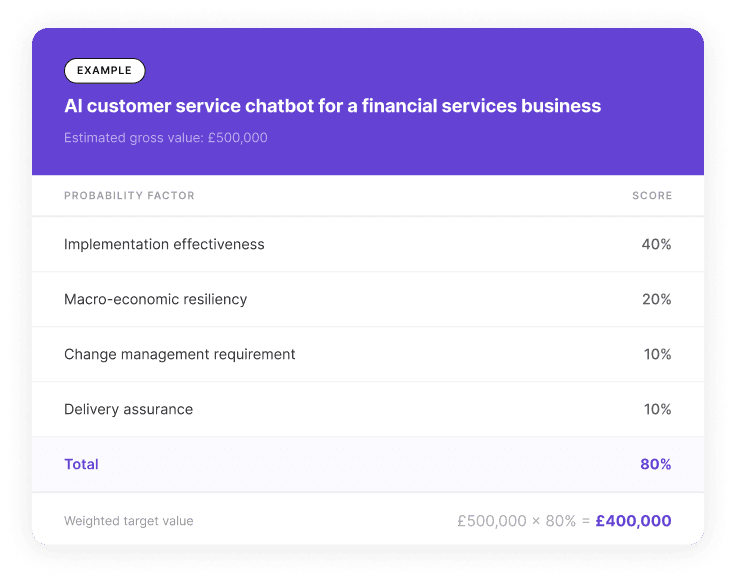
When looking at the potential uplift or cost reduction, probability is also important to model out. Building a probability view into the case reflects implementation reality and ensures that all variables are built into the target figures.
We typically break down probability into the following four areas:
- Implementation effectiveness: How directly does the product change drive this value lever? (Up to 50%)
- Macro-economic resiliency: How exposed is this benefit to external market conditions? (Up to 20%)
- Change management requirement: How much organisation/behavioural change is needed for the benefit to materialise? (Up to 20%)
- Delivery assurance: How confident are we in technical and delivery execution? (Up to 10%)
Step 4: Make it repeatable
Building out a business case takes time and starting from scratch with no consistent structure/framework creates more unnecessary duplicated effort. We would recommend adopting a consistent framework and methodology which can be applied time and time again, this will allow for comparison of business cases over time, ensure there is the right rigour in place (regardless of who is building the case or sponsoring it) and hopefully also save time across the team!
This also doesn’t need to be manual or be bound to spreadsheets and PowerPoint slides. We have trained AI models and built interactive dashboards to bring these business cases to life.
What next? Signing off the business case is not the same as being ready to deliver
A strong business case tells you what you are backing and what you expect in return and gets you to the starting line.
But the benefit is only gained if your organisation can actually execute- and that is a separate and equally important question. Do you have the right data, is your underlying technology stack able to support AI and most importantly is your operating model ready to transform to blend AI X Human ways of working?
In our upcoming thinking, we look at exactly that and launching a tool to help organisations assess their AI readiness honestly before they commit.