November 27, 2025

AI is reshaping how people travel, from the first spark of inspiration through to arriving home. What was once a fragmented journey of switching between platforms and piecing together information is becoming something more fluid. Brands can anticipate what travellers need, personalise interactions in the moment, and guide them through each stage of the trip. For businesses, this shift goes beyond innovation. It drives measurable improvements in engagement and conversion while fundamentally changing what travellers now expect from a seamless experience.
From reactive to contextual personalisation
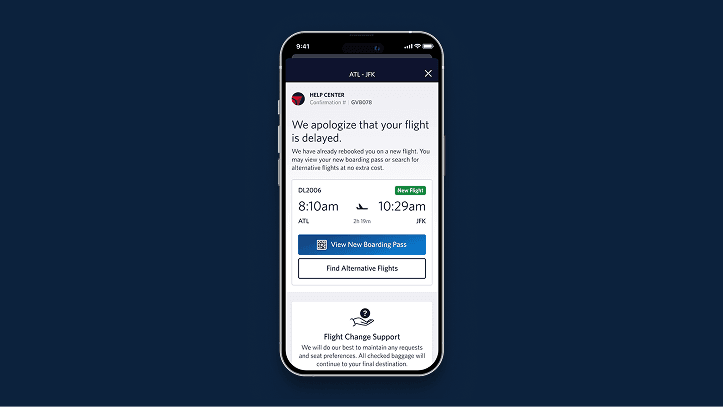
Travel personalisation is moving beyond static profiles to real-time intelligence. Modern AI models now read a traveller’s context, such as weather, location, trip stage, and operational events like delays or cancellations. This enables brands to surface what the traveller needs at that moment. If a flight is delayed or at risk, the interface can instantly adapt by offering lounge access, hotel vouchers, rebooking options, or rearranging the app journey so the most urgent actions appear first.
Contextual personalisation also supports more relevant recommendations across a traveller’s wider ecosystem. If a user arrives late, AI can suggest nearby late-night dining. If rain is forecast, indoor experiences can be emphasised. These subtle touches create the impression of a companion that understands timing, intent, and mood rather than a generic booking engine.
Delta Air Lines is a strong example. Its Fly Delta app updates dynamically during disruptions, highlighting rebooking and compensation options, and guiding travellers with wayfinding tools in-airport. The airline has been exploring innovative ideas in this space for some time now. Back in 2022, the airline’s Parallel Reality installation took personalisation into physical space at Detroit airport. After opting in by scanning their boarding pass, travellers are tracked by positional sensors, and a multi-viewpoint pixel display presents different information to different people from the same screen without AR glasses or devices. More recently, they rolled out their Delta Concierge, an AI-powered digital assistant inside the app for SkyMiles members that provides real-time and personalised support, from gate changes to baggage tracking to loyalty benefits; it acts like a true travel companion.
As travellers spend more time tailoring trips to their interests, as noted in Skyscanner's 2026 Travel Trends report, contextual personalisation gives brands a meaningful edge. WebEngage reported that deeper personalisation even increased retention by up to 30 percent for one of the Saudi Arabian travel brands they work with.
Conversational companions
Messaging-based AI assistants are redefining how travellers interact with brands by offering natural, frictionless support. Air India's Maharaja assistant handles hundreds of thousands of queries across multiple languages, covering everything from baggage to booking. American Airlines uses generative AI to help travellers rebook disrupted flights, access loyalty benefits, and receive vouchers instantly.
These systems do more than automate simple tasks. They maintain a continuous connection throughout the traveller's journey—responding instantly when things go wrong, surfacing relevant offers at the right time, and generally making the brand feel present when it matters most. That persistent, helpful presence builds loyalty in ways that traditional touch points can't.
Immersive previews and XR tourism
Extended reality is closing the gap between inspiration and decision-making. Emirates offers virtual cabin tours that let travellers explore products before booking, whilst tourism boards such as Singapore Tourism have trialled AR overlays for on-the-ground guidance.
XR reduces the uncertainty that comes with premium purchases, while creating a richer emotional connection earlier in the travel journey. Seeing a first-class cabin or walking through a potential travel destination makes the decision feel less abstract.
Preparing for the Atlas era
New browsers such as ChatGPT Atlas are likely to disrupt how people explore and plan trips going forward. Instead of browsing multiple websites, travellers may simply ask for an itinerary and receive a personalised plan instantly. For brands, visibility will depend less on SEO or app journeys and more on how well an AI can access and action their data.
This is where Model Context Protocols, or MCPs, become essential. MCPs allow brands to securely expose real-time availability, pricing, loyalty information, disruption workflows, and booking functions to AI assistants. Brands that adopt MCPs early will have their services properly represented and recommended when travellers turn to AI for trip planning.
Just as early SEO adopters won in the search era, early AI optimisation will shape success in the AI-first era. Brands that enable agentic actions, such as rebooking, upgrades, or issuing vouchers through MCPs, might be in the lead when it comes to delivering smoother experiences and building loyalty at scale.
The road ahead
AI is turning travel from a series of transactions into a continuous relationship. As large-scale assistants evolve into agentic systems, they will not only plan but also act on the traveller’s behalf. This could include automatically rebooking cancelled flights, adjusting hotel check-in times, reshaping itineraries around weather, or even making recommendations that reflect a traveller’s wellbeing, such as balancing busy days with more restful activities.
Travel brands that combine contextual personalisation with conversational AI, immersive previews, and emerging agentic capabilities can create journeys that feel genuinely thoughtful. The future of travel lies in experiences that move with the traveller, adapting continuously rather than forcing people to adapt to rigid systems.